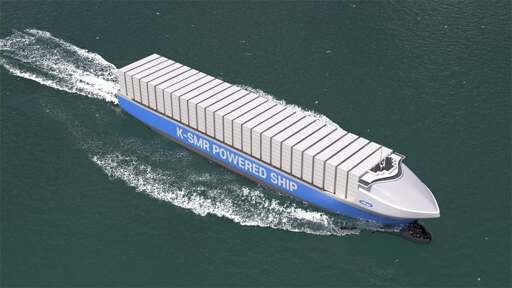
Korean researchers working with Samsung Heavy Industries have cleared a key hurdle in their efforts to develop designs for a containership powered by...
When a naval reactor fails it gets submerged in water. When an inland reactor fails it either gets submerged in water or the area potentially becomes uninhabited for generations. It’s really all about access to water. Even an island nation like Japan has had trouble keeping nuclear reactors full of water in the past, e.g. Fukushima.
And? So what? There are 9 sunken nuclear submarines on the ocean floor, about 700 Nuclear vessels have sailed since the 1950s and about 200 are current.
They generate a little heat but thats about it. The water shields the outside world from wide spreading bursts of radiation.
The isolation condenser (IC) was functioning prior to the tsunami, but the DC-operated control valve outside of the primary containment had been in the closed position at the time to prevent thermal stresses on the reactor components. Some indications in the control room stopped functioning and operators correctly assumed loss of coolant (LOC). At 18:18 on 11 March, a few hours after the tsunami, operators attempted to manually open the IC control valve, but the IC failed to function, suggesting that the isolation valves were closed. Although they were kept open during IC operation, the loss of DC power in unit 1 (which occurred shortly before the loss of AC power) automatically closed the AC-powered isolation valves to prevent uncontrolled cooling or a potential LOC. Although this status was unknown to the plant operators, they correctly interpreted the loss of function in the IC system and manually closed the control valves. The plant operators would continue to periodically attempt to restart the IC in the following hours and days, but it did not function.


When a naval reactor fails it gets submerged in water. When an inland reactor fails it either gets submerged in water or the area potentially becomes uninhabited for generations. It’s really all about access to water. Even an island nation like Japan has had trouble keeping nuclear reactors full of water in the past, e.g. Fukushima.
Interestingly, seawater corrosion can actually cause criticality for nuclear reactors instead of preventing it.
And? So what? There are 9 sunken nuclear submarines on the ocean floor, about 700 Nuclear vessels have sailed since the 1950s and about 200 are current.
They generate a little heat but thats about it. The water shields the outside world from wide spreading bursts of radiation.
Er, wasn’t the problem at Fukushima caused by the plant being full of water?
The isolation condenser (IC) was functioning prior to the tsunami, but the DC-operated control valve outside of the primary containment had been in the closed position at the time to prevent thermal stresses on the reactor components. Some indications in the control room stopped functioning and operators correctly assumed loss of coolant (LOC). At 18:18 on 11 March, a few hours after the tsunami, operators attempted to manually open the IC control valve, but the IC failed to function, suggesting that the isolation valves were closed. Although they were kept open during IC operation, the loss of DC power in unit 1 (which occurred shortly before the loss of AC power) automatically closed the AC-powered isolation valves to prevent uncontrolled cooling or a potential LOC. Although this status was unknown to the plant operators, they correctly interpreted the loss of function in the IC system and manually closed the control valves. The plant operators would continue to periodically attempt to restart the IC in the following hours and days, but it did not function.