

9
:parchlinux: Parch Linux | پارچ لینوکس (@[email protected])
ieji.deAttached: 2 images
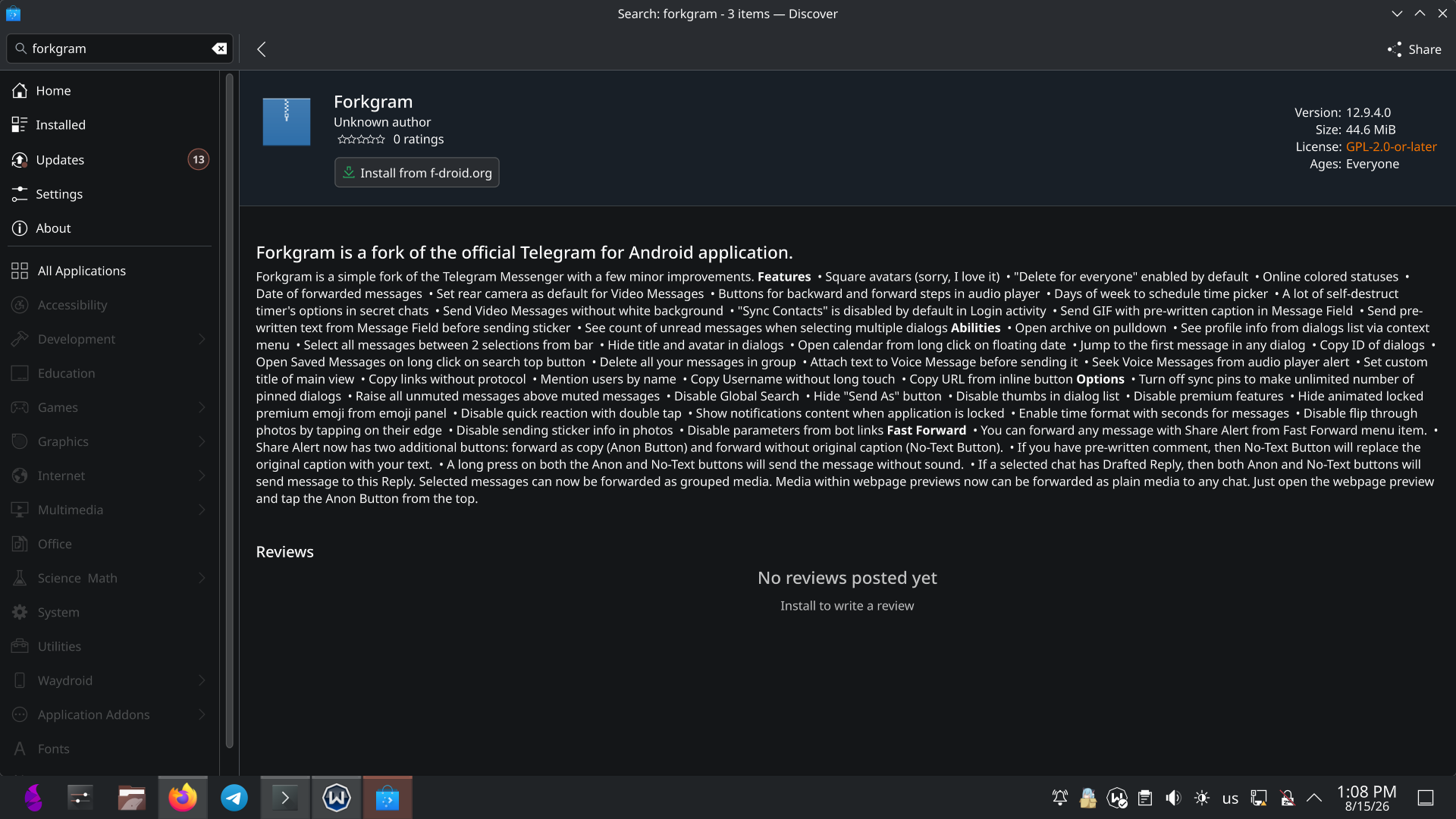
As part of Parch Linux Mobile and Project Apadana, the immutable edition of Parch GNU/Linux, we're working on a new Proof of Concept aimed at making Android applications a first-class part of the Linux software experience.
Today, installing an Android application on Linux can still feel disconnected from the rest of the desktop. You may need to find an APK yourself, download it, open a terminal, and manually install it into Waydroid.
We want to make that experience much simpler.
The PoC introduces `libfdroid`, a standalone library designed to communicate with F-Droid repositories, parse their application catalogues, understand application versions and metadata, handle APK information, and provide a clean API that other applications can use.
On top of `libfdroid`, we're building a KDE Discover backend that presents F-Droid applications inside Discover. Waydroid acts as the Android runtime underneath it, so the user can discover an application, view its description and metadata, choose a compatible version, and install it directly into their Waydroid environment.
The important part is that we're deliberately keeping the F-Droid functionality separate from Discover.
`libfdroid` isn't a Discover library. It doesn't know about KDE, Plasma, Waydroid, or any particular software center. It is intended to be a reusable piece of infrastructure for the wider Linux ecosystem.
That means the same library can eventually power other applications and software centers. One of the planned integrations is GNOME Software, allowing GNOME users to access the same F-Droid catalogue and Android application ecosystem without requiring a separate implementation of the F-Droid repository format.
The long-term architecture looks roughly like this:
`F-Droid → libfdroid → Discover / GNOME Software / other clients`
while Waydroid provides the actual Android runtime and installation layer.
We're also designing this with different Android architectures in mind. The system should be able to determine what the Waydroid environment supports and select an appropriate APK rather than blindly assuming that the Linux host architecture is the same as the Android environment.
Security and reliability are also part of the design. APK metadata from F-Droid includes information that can be used to verify downloaded files, so the installation process can verify the APK's SHA-256 checksum before handing it over to Waydroid. More advanced repository and signing verification can be added as the project matures.
For now, this is a Proof of Concept rather than a finished product. We're using it to validate the architecture and figure out how well F-Droid, Waydroid and existing Linux software centers can work together.
The source code will be published later in the official Parch Linux GitHub organization once the project reaches a suitable stage of development.
Our goal isn't to turn Discover or GNOME Software into Android-specific projects. Instead, we want to build a small, reusable layer that allows existing Linux software centers to understand F-Droid and lets projects such as Parch Linux Mobile and Apadana provide a more seamless experience for running free and open-source Android applications.
This is one of the pieces we're exploring as we work toward a more complete mobile and immutable Linux experience with Parch.
#ParchLinux #ParchLinuxMobile #Apadana #Linux #FOSS #FDroid #Waydroid #KDE #GNOME #OpenSource
You must log in or register to comment.